01 June 2012

OF LOFT APARTMENTS AND RESTAURANT OPEN KITCHENS

Andy Warhol in the "Silver Factory" loft, 1964-68. Photo probably by Billy Linich.
Can anyone think of another workspace besides the artist loft and the restaurant open kitchen that, in recent decades, has become so ubiquitous as a chic, upscale commodity?

I will be speaking about the appeal of both spaces as ideal models of "creative-artisanal" labor on the "Food and Arts" panel of the "Global Gateways and Local Connections" food-studies conference. The event is jointly hosted by NYU and The New School this June. Come by if you are in town and have interest in the topic!

02 April 2012

ANNOUNCING "SMART CASUAL"


"Philly Cheesesteak" at minibar, Washington, D.C., 6 August 2010. Photo by author.


Dining counter at Saison, San Francisco, 8 September 2010. Photo by author.


Terrific news: The University of Chicago Press will publish SMART CASUAL. It's an ideal read for anyone interested in the history and fashions of restaurants and gourmet dining. There'll be something new to chew on for the seasoned professional and the foodie novice.

SMART CASUAL is an in-depth look at how the fine-dining restaurant in America changed from a hushed scene of chandeliers and closed kitchens, strict dress codes and Continental cuisine, to a clamorous place where diner-style decor and hamburgers are no longer impediments to a Michelin star...or two. It also recognizes the simultaneous rise of new formalities, such as the elaboration of tasting-menu rituals. While they may seem contradictory, I consider these tendencies as part of a cohesive "omnivorous" turn in gourmet taste.  The book uncovers the key dining rooms and trends that mark the rise of "omnivorous" preferences, and considers the changes in taste in light of broader shifts in the definition of elite social status.

The book has academic rigor, but jargon-free prose. It draws on extensive archival research as well as participant-observation and interviews with major players. It considers the cuisine as much as the environments of restaurants. SMART CASUAL picks up in time where Patric Kuh's THE LAST DAYS OF HAUTE CUISINE (2001) leaves off, but, unlike it, puts the focus on visual aesthetics.

I will post updates here and via my Facebook page (The Eye in Dining) and Twitter (theeyeindining) as soon as I have further details to share related to the project and its release. Thank you for your interest.

03 March 2012

Special Post: VOSS for DINNER?

     On leap day--February 29, 2012--a panoply of Los Angeles food bloggers and magazine writers gathered at FIG restaurant, in Santa Monica, for a special chef's tasting menu. Sensory pleasure and good company were not, however, our only motives. The festivities were designed to benefit the VOSS Foundation's "Give a Drop" campaign.
Company at table
Glaum Ranch Hen's Egg with Truffle and Asparagus
     The event was a reminder of cultural contrasts. Chef Ray Garcia is well known for highlighting, with a spare grace, local and bountiful foods. He stocks his walk-ins from the overflowing Santa Monica Farmer's Market, and, through the restaurant's regular forager, taps other fecund fields in California. Note the captions under the special-tasting-menu items pictured here. They all emphasize the local origins of ingredients.
Rabbit with McGrath Farm's English Peas
Sonoma Lamb with Carrots and Harissa
Pudwill Farm's Blackberry Pavlova with Vanilla Mousse
Contrast this situation of local abundance and easy access to high-quality foods with the focus of the dinner's sponsor--the distant and unyielding terrain of Sub-Saharan Africa. There, even access to clean water, never mind the likes of humanely raised lamb, is a daily challenge. 
VOSS  Foundation banner
     VOSS has been addressing this discrepancy. Since 2008, VOSS has helped construct thirty-two water access points in five African countries. With their "Give a Drop" campaign, you can help the cause by texting DROP to 89544 on any U.S. mobile phone. $5 will be donated automatically to the campaign. See? Even this is easy-access for many of us over here!

30 August 2011

LQ@SK IS "SMART CASUAL"

The pop-up restaurant LQ@SK epitomizes the trend toward an "omnivorous" taste for combinations of informal and formal style I discuss in my forthcoming book, Smart Casual. Starry Kitchen's mod chalkboard-menu digs set the relaxed stage for chef Laurent Quenioux's refined six-course menu. Knowledgeable and on-point servers wore t-shirts, cargo shorts, sneaks, and smiles. Starry Kitchen's Nguyen Tran made me feel so welcome with his disarming unpretentiousness! He offered his cell phone light for my photos of dishes. He could see that my too-weak Flashlight app in the corner table wasn't going to cut it. Here's a quick rundown of the place and the night's menu post Flashlight-app fiasco:


Hi, Nguyen! Thanks for your hospitality and that of your staff.

Not pictured:
Course #1: Amuse Bouche: Cocks Comb Tempura, Chipotle Lamb Kidney, Clementine, Vanilla.

Bold beginning. Concentrated, rich flavors, almost like mole or gumbo in intensity. Tender cocks comb. Delicious.

Not pictured:
Course #2: Hamachi, Black Sesame Panna Cotta, Soy Gel, Avocado Smear, Pickled Cucumbers, Black Sesame Powder.

Suprising that second course was so subtle in flavors. Unusual tactic, not proceeding from lighter to bolder. Black Sesame Panna Cotta was out of this world.

Course #3: Ham Hock Bouillon, Cabbage, Poached Smoked Salmon in Lard, Lentil Creme Fraiche.

I love chef Quenioux's decadent streak. More please!
Course #4: Declination of Peas: Pea Guacamole, Pea Gazpacho, Pea Bacon Ragu, Sauteed Foie Gras.

The declination, I believe, was in intensity of flavors, so goes counterclockwise. Every dish in this meal was a success. More declination, peas!
Course #5: Veal 2-Ways: Veal Tenderloin Tartare Tonato Style, Veal Sweatbread, Clear Watercress 'Spaghetti,' Uni Lobster Coulis.

Chef is so far including most of my favorite ingredients. Uni with sweatbreads really works. The veal tartare was a play on the classic Italian dish. It also showed the dish's renewed relevance today, as it upends the vegetarian/vegan tendency to fake the forbidden foods with mock versions. The fakery is in reverse--veal mocking tuna.

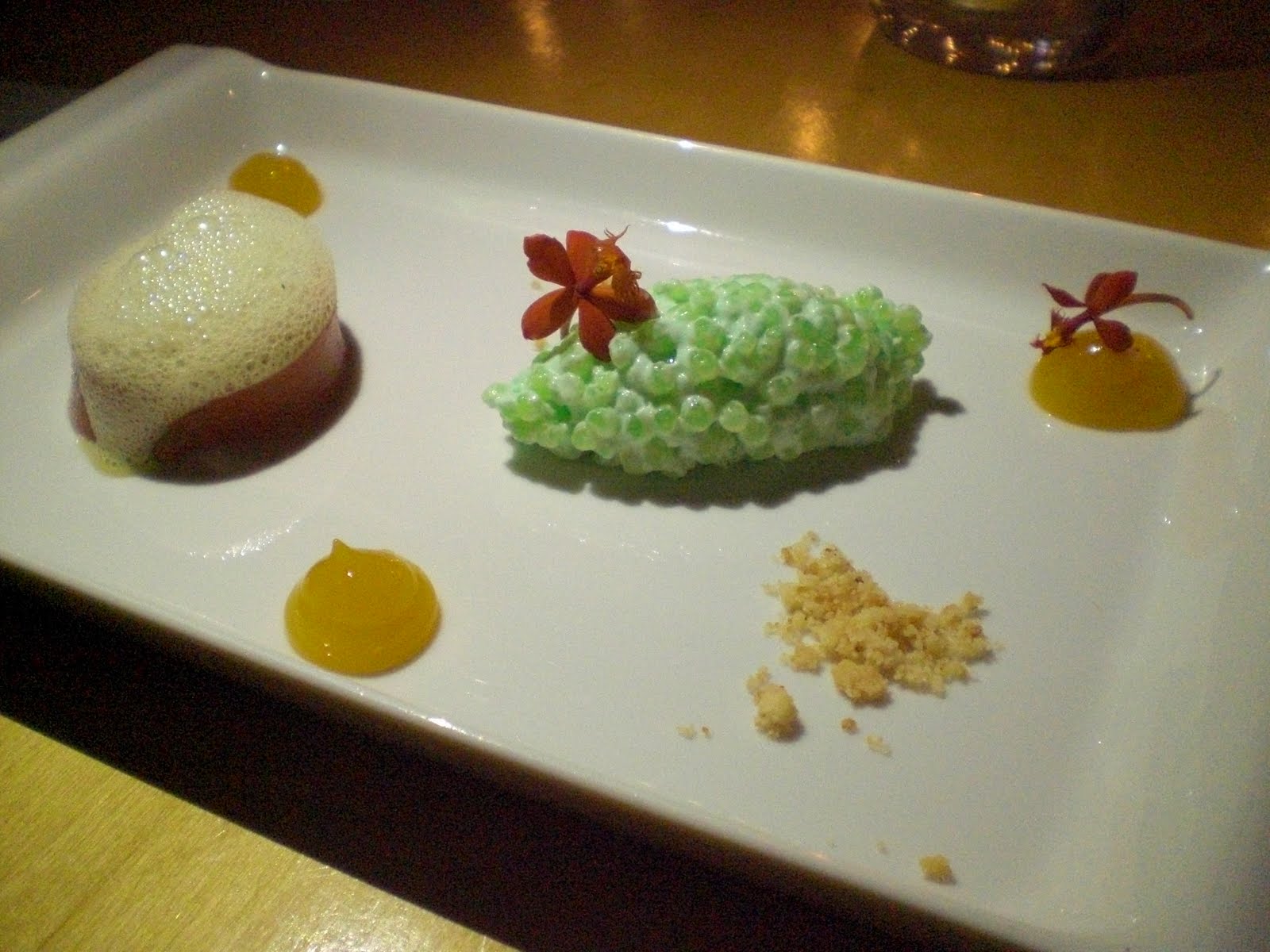
Dessert Course: Pandan Coconut Tapioca, Guava Gelee, Passion Fruit, Green Tea Emulsion.

Every element sung here. That edible flower, BTW, tasted like a watermelon. No joke.

It happened to be chef Quenioux's birthday on this evening. The Starry Kitchen team has a good camp sense of humor. I love the juxtaposition of this dessert with chef's!


Copyright 2011 Alison Pearlman. All rights reserved.

Bookmark and Share

10 February 2011

EATING HISTORY

Heston Blumenthal with Dinner head chef Ashley Palmer Watts. From http://www.dinnerbyheston.com/.

Grant Achatz with chefs Craig Schoettler and Dave Beran--creators of Next restaurant, Chicago. From Facebook.

In Venice, Italy, there's a superb and very old haute-cuisine restaurant, Le Bistrot de Venise, whose specialty is a menu of dishes based on historical Venetian cuisine. The items on this special menu, served in modified form to suit contemporary tastes, are accompanied by the dates of recipes from which they are drawn. Some go back to the fifteenth and sixteenth centuries. I thought this restaurant had a fairly unusual concept. Lately, however, historicity is in.

Two recent developments have gotten me wondering about the significance of historicity as an avant-garde food trend. One is the recent opening of Heston Blumenthal's restaurant Dinner at the Mandarin Oriental Hyde Park in London, a restaurant inspired by historic British gastronomy. Go to the website (www.dinnerbyheston.com) and you will first encounter a brief history lesson in a typeface and layout that vaguely conjures old newspapers: "In the past, the main meal--dinner--was eaten at midday, before it got dark. But affordable candles and, later, gaslight saw dinner shift." Check out the menu on the site and, in the appetizer section alone, you will find the items accompanied by dates that range from "c. 1390" to "c. 1820." Blumenthal and Dinner's head chef Ashley Palmer-Watts don't intend these dishes to be faithful copies of historical dishes. They are "inspired" by them. If not actually historical, the concept of Dinner is saturated with the idea of historicity.

Another case is the almost-opened and fiercely hyped Next restaurant. Chicago's Grant Achatz and his chef team of Craig Schoettler and Dave Beran describe Next as a restaurant designed to represent world cuisines from various great moments in culinary history--and the future. They will present four menus per year, each one dedicated entirely to a specific period and place. Unlike Blumenthal, Achatz intends to present dishes in historically authentic form--true to Paris, 1912, say, or Sicily, 1949. But, of course, like Blumenthal, Achatz can't help but be inventive. One of the options advertised for Next is Hong Kong, 2036. Even these masters of culinary history can't have much evidence to go on for the recreation of this one!

Indeed, Next bubbles over with experimental quirks. Achatz will not sell traditional "reservations" but rather all-inclusive "tickets" for particular, differentially-priced time slots at the restaurant. Though little different from a reservation in actual fact, the ticket's association with film or theater changes the psychological game. In that spirit, Achatz has promoted the restaurant through a film trailer that, like film trailers, encapsulates a narrative (in this case, of time travel) and fills the viewer with a sense of mystery and anticipation.

Why have two of the world's most avant-garde chefs made history the theme of their newest ventures? Why are these ambassadors of the hyper-new looking back?

First, let's acknowledge the fact that Blumenthal's and Achatz's concepts and menus are faithful to the past only to the extent that it "inspires" their creativity. They are launching something new in the process--a new restaurant format or an original interpretation of an historical dish. Is history just the latest frontier to excite an ever-jaded audience for the new?

This may be true, but I think it's not the whole story. I would argue that these chefs' choice to put history in the foreground is really an overdue revelation of their culinary practices so far. Every one of the chefs associated with the so-called "molecular" or "techno-emotional" cuisine, as are Blumenthal and Achatz, when charged with culinary futurism, has insisted on their work's profound connection to memory. They take tried and true dishes and "deconstruct" them. Or they take traditional ingredient combinations and alter their relationships in texture, temperature, proportion, etc. The historical reference is integral. The very intelligibility of these chefs' far-out cuisine depends on their experiments' grounding in tradition. It seems only right, then, that their historical aspect become overt.

Copyright 2011 Alison Pearlman. All rights reserved.


Bookmark and Share